
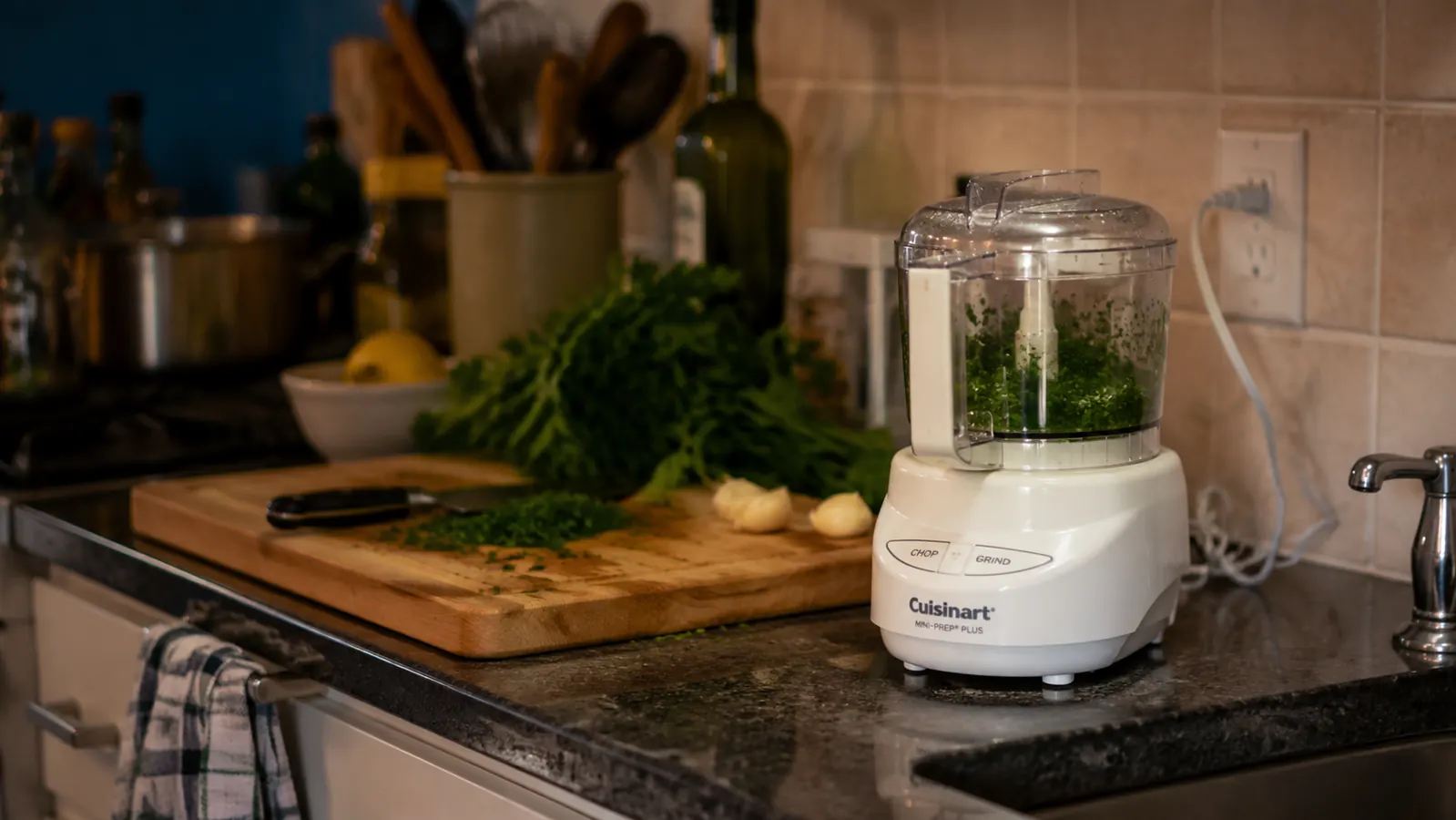
Here is what the product listing for the Cuisinart Mini-Prep Plus does not tell you upfront: the two controls are not labeled 'low' and 'high.' They are labeled 'Chop' and 'Grind.' That sounds like a minor distinction until you are standing over a bowl of fresh basil at 7 p.m. trying to figure out which button makes pesto and which one turns it into paste. I pressed the wrong one. The basil went from roughly chopped to completely pureed in about four seconds, which was not what I wanted. This is the kind of thing nobody mentions in the marketing copy, and it is exactly the thing this review covers.
I have been using the Cuisinart Mini-Prep Plus in a Dallas one-bedroom apartment for roughly three months. My kitchen has about 9 feet of counter on one wall, a gas range, no dishwasher, and the kind of overhead cabinet situation where every appliance has to justify its assigned square footage to stay. The Mini-Prep Plus is currently 7 inches wide by 6 inches deep and lives on the counter permanently. Here is what I learned about it that I wish the listing had told me first.
The Quick Verdict
A compact, capable food processor that handles garlic, herbs, onion, and soft vegetables fast -- but the two-speed system takes a session to learn, and it is not a puree machine for thick sauces.
Amazon Check Today's Price →Seven Inches Wide. Handles Garlic in 8 Seconds. Check the Current Price.
The Cuisinart Mini-Prep Plus 3-cup food processor is one of the most compact full-function choppers available. Check today's price and availability on Amazon before deciding.
Amazon Check Today's Price on Amazon →How I Actually Tested It
I ran the Cuisinart Mini-Prep Plus through the tasks I cook most often on weeknights: mincing garlic (4 to 6 cloves at once), chopping a medium yellow onion, rough-chopping walnuts for a grain bowl, processing fresh herbs into chimichurri, making a small batch of hummus, and breaking down roasted red peppers for pasta sauce. I deliberately skipped any test that required a larger machine -- I wanted to understand what this specific 3-cup unit handles well and what it quietly declines.
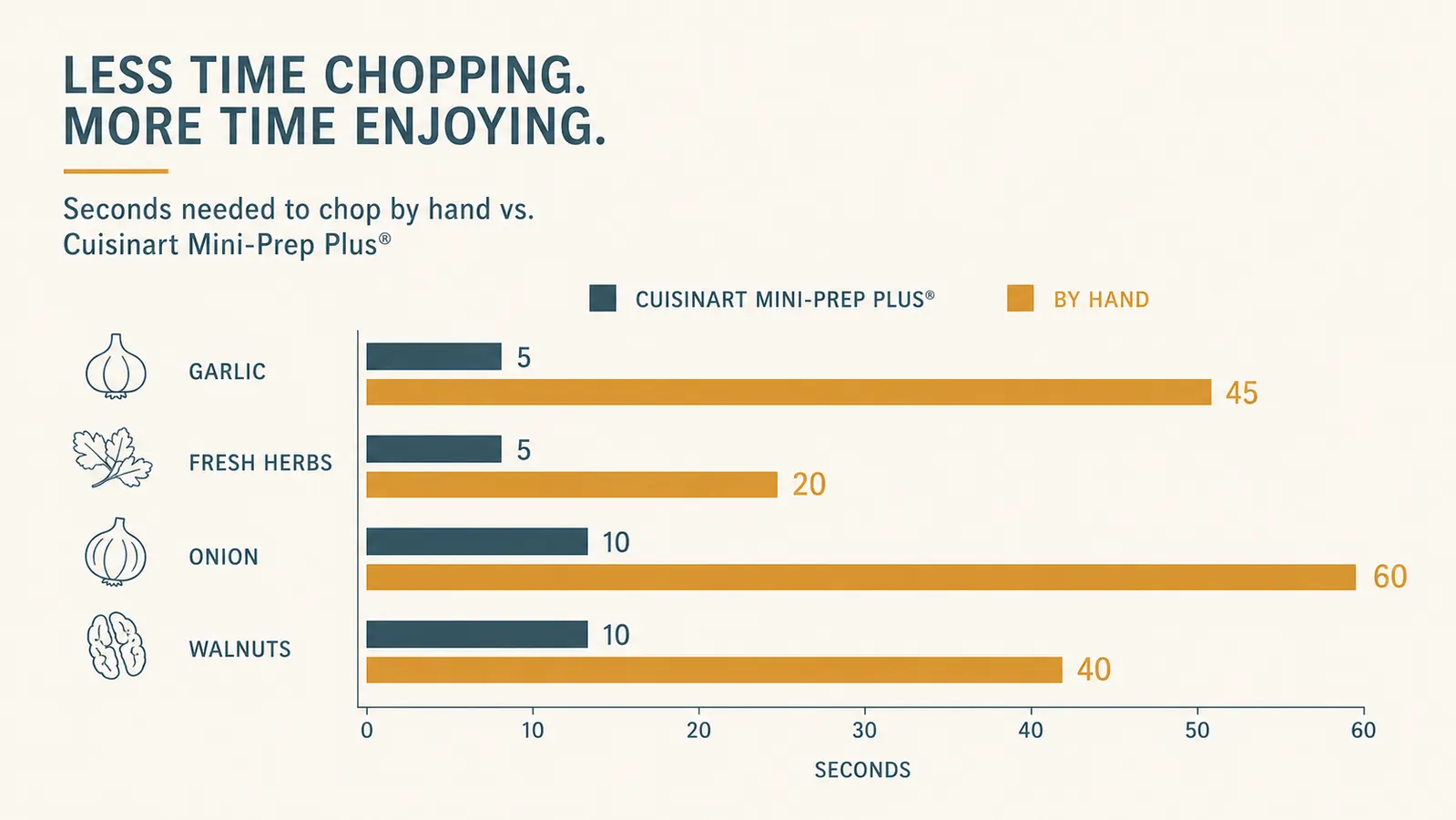
I also timed myself doing each task by hand first, then with the machine, to get a real read on the time savings versus a knife. On garlic: hand chopping 5 cloves took me about 90 seconds. The Mini-Prep Plus processed the same 5 cloves in 8 seconds of actual run time plus about 30 seconds of setup and cleanup. That is not a fair comparison on paper, but in practice, setup is a lid-on, lid-off motion that becomes automatic after the third use. The time math favors the machine for anything beyond a single clove.
I paid attention to things most reviews skip: how loud it is, whether the bowl leaks at the bottom seal, how hard the blade is to remove safely, whether the rubber grip on the base actually keeps it from walking across the counter, and what happens when you try to process something slightly too dry or too wet for the stated capacity.
What Nobody Tells You About the Mini-Prep Plus Before You Buy
The two speeds are really two modes, not two power levels. 'Chop' runs the blade forward, which cuts food into pieces. 'Grind' reverses the blade direction and uses the blunt back edge, which crushes rather than cuts -- it is designed for hard items like coffee beans, spices, and nuts. Most people (including me, initially) use it like a two-speed blender and miss the actual functional difference. Once you understand which mode does what, the control logic makes complete sense. Until then, it is genuinely confusing.
The blade is sharp enough to cut your hand if you are not paying attention when removing it from the bowl. This is not a Cuisinart-specific problem -- it is true of every food processor blade -- but the Mini-Prep Plus blade feels sharper than the blades on larger units I have used, possibly because of the smaller radius. I handle it by reaching in from the side and lifting by the plastic center post, never by gripping the cutting edges. Worth knowing before your first use.
The bowl bottom seal leaks slightly if you run liquid-heavy batches at full capacity. I discovered this making a chimichurri with olive oil. At 3 cups of mixed herbs and oil, a thin ring of oil appeared at the base of the bowl after about 15 seconds of continuous running. It was not a flood, and the machine did not fail -- but it reinforced the real working capacity. I now fill the bowl to about 2.25 cups of soft, wet ingredients and have had zero leakage since.
The machine is louder than you expect from something this size. Running at full speed, it lands around 80 to 85 decibels -- similar to a standard countertop blender. This is not unusual for a small motor working hard, but the form factor makes people expect something quieter. If you are processing a batch of onions in a studio apartment at 7 a.m. on a weekday, your neighbors will know. Build this into your cooking schedule.
Where the Cuisinart Mini-Prep Plus Is Genuinely Excellent
Garlic is its best use case, and it is not close. Five cloves, rough-cut into chunks, processed for 8 seconds on Chop produces a consistent mince with no single large pieces left. If you cook with garlic four or more nights per week -- which I do -- this alone pays for the appliance in time savings inside a month. The bowl rinses out in 20 seconds.
Fresh herbs are its second-best use. Flat-leaf parsley, cilantro, and basil all process cleanly in Chop mode with no bruising if you keep pulses short -- 3 to 4 one-second pulses rather than holding the button down. The key is not running it continuously for soft herbs. Short pulses give you a rough chop; holding it for 10 continuous seconds gives you paste. Both outcomes are achievable with the same machine, which means the technique matters more than the hardware.
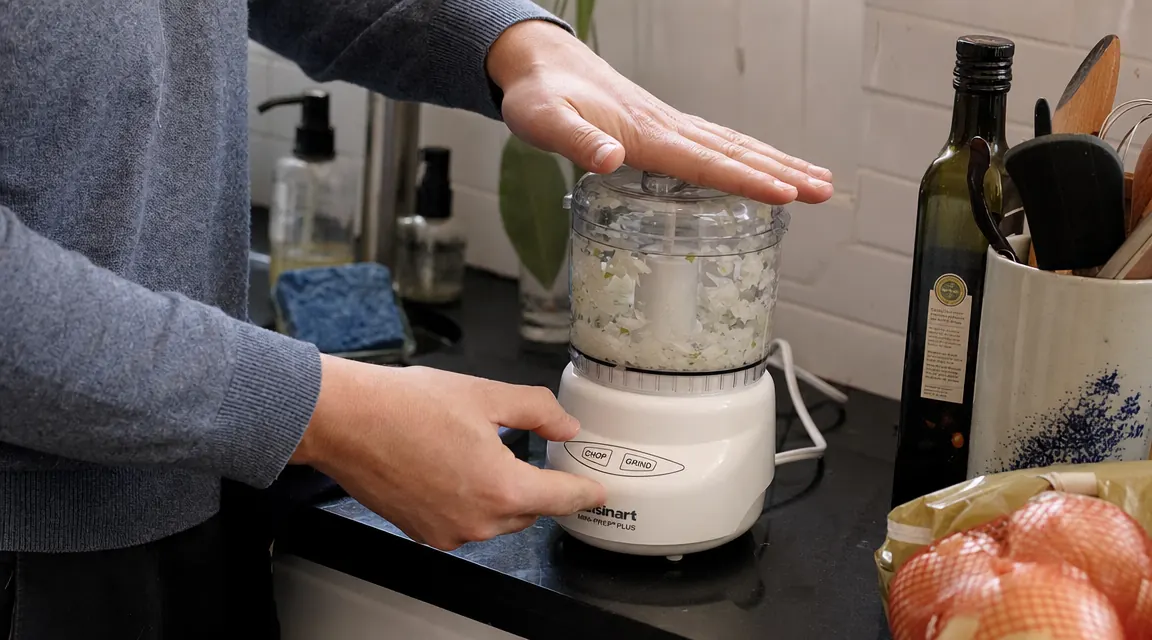
Onions are excellent. One medium onion, halved and cut into rough pieces, processes into an even dice in about 6 seconds on Chop. No tears, no knuckle exposure to the blade, done in one motion. This is the task where the Mini-Prep Plus replaces the most hand work in a real cooking routine -- onions appear in more weeknight recipes than almost anything else, and hand-dicing a medium onion takes me a minimum of 2 to 3 minutes even when I am moving efficiently.
Walnuts and almonds in Grind mode process into a coarse chop for grain bowls or a fine grind for baking in about 10 to 12 seconds. The reverse blade direction matters here -- the blunt edge crushes nuts evenly without driving them into the bowl walls the way a forward blade tends to.
Garlic is the Mini-Prep Plus best use case, and it is not close. Five cloves processed in 8 seconds, consistent mince, no large pieces left. If you cook with garlic four nights a week, this pays for itself in time savings inside a month.
Where the Mini-Prep Plus Falls Short and What to Do About It
Thick, paste-heavy sauces stress the motor noticeably. I tried making a chickpea hummus at full 3-cup capacity with the standard olive oil and tahini ratio. The motor started running hot (the unit gets warm to the touch on the bottom) after about 45 seconds of processing, and the result was gritty rather than smooth. I had to process in two batches and add extra liquid to get a texture worth serving. The Mini-Prep Plus is a chopper, not a high-speed processor. It handles soft and semi-firm ingredients well; it struggles with dense pastes.
Cheese is hit or miss. Soft cheeses like feta process fine. Block cheddar at room temperature works in short pulses if you cut it into small cubes first. Cold hard cheese from the fridge -- the kind you would want to grate over pasta -- bounces off the blade and leaves large chunks. Buy pre-shredded or use a box grater for hard cheese. The Mini-Prep Plus is not a cheese shredder.
The run time ceiling matters more than the spec sheet suggests. Cuisinart recommends no more than 60 continuous seconds of operation. I tested at 90 seconds on a dense batch and the motor thermal protection tripped -- the unit stopped running and required a 15-minute rest before starting again. This is a safety feature, not a defect, but it means the Mini-Prep Plus is a batch-and-rest machine, not a continuous processor. For most small-kitchen cooking tasks this limit never matters. For anyone planning to process large batches in sequence, factor in the rest cycle.
The Footprint Honestly: What 7 by 6 Inches Actually Means
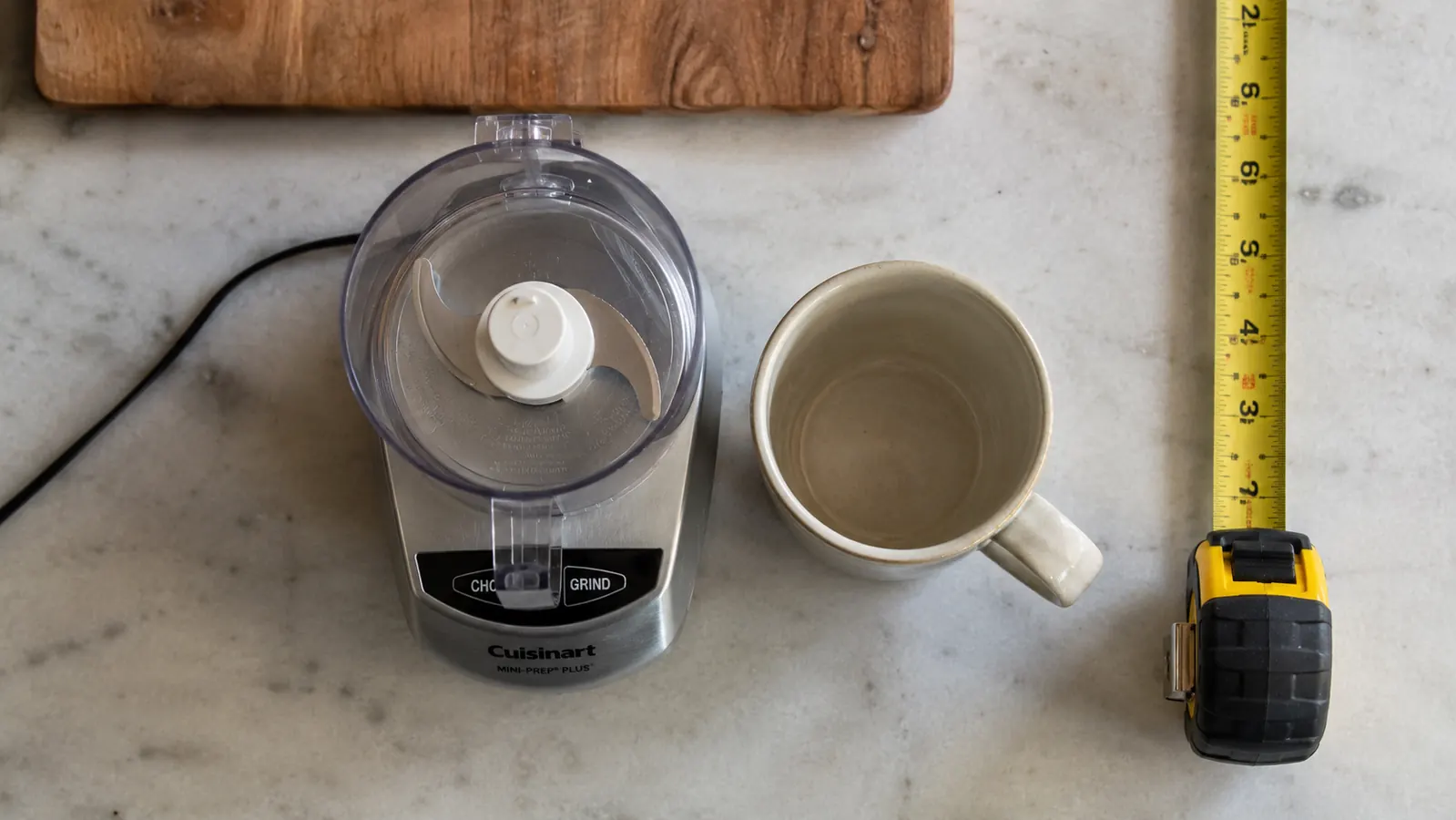
The Mini-Prep Plus is 7 inches wide, 6 inches deep, and 11 inches tall. That tall dimension matters if your overhead cabinets sit low. In my kitchen, the cabinets clear the counter by about 16 inches, which gives the Mini-Prep Plus 5 inches of clearance above the lid -- enough to work comfortably without removing it from the counter. If your cabinets sit lower than 14 inches above the counter surface, you will be tucking the Mini-Prep Plus under the cabinet for storage and pulling it out to use it. That is a 30-second move, but it changes whether this lives permanently on your counter or comes in and out of a cabinet.
The base grip is rubber and it works. I pushed down hard on the lid during a stubborn nut-grinding batch and the machine did not skid. This matters more than it sounds -- a chopper that slides while you are pressing down on it is a safety issue and an annoyance. The grip is one of the better design details on this unit.
For context: the Mini-Prep Plus occupies a smaller footprint than most full-size toasters. If you are currently running a 4-slice toaster and could swap to a toaster oven, you could free up enough space to fit the Mini-Prep Plus on the cleared strip of counter without losing net working surface. This is the square-inch trade-off I made in my own kitchen and it worked out.
Cleaning Honestly: Faster Than You Think
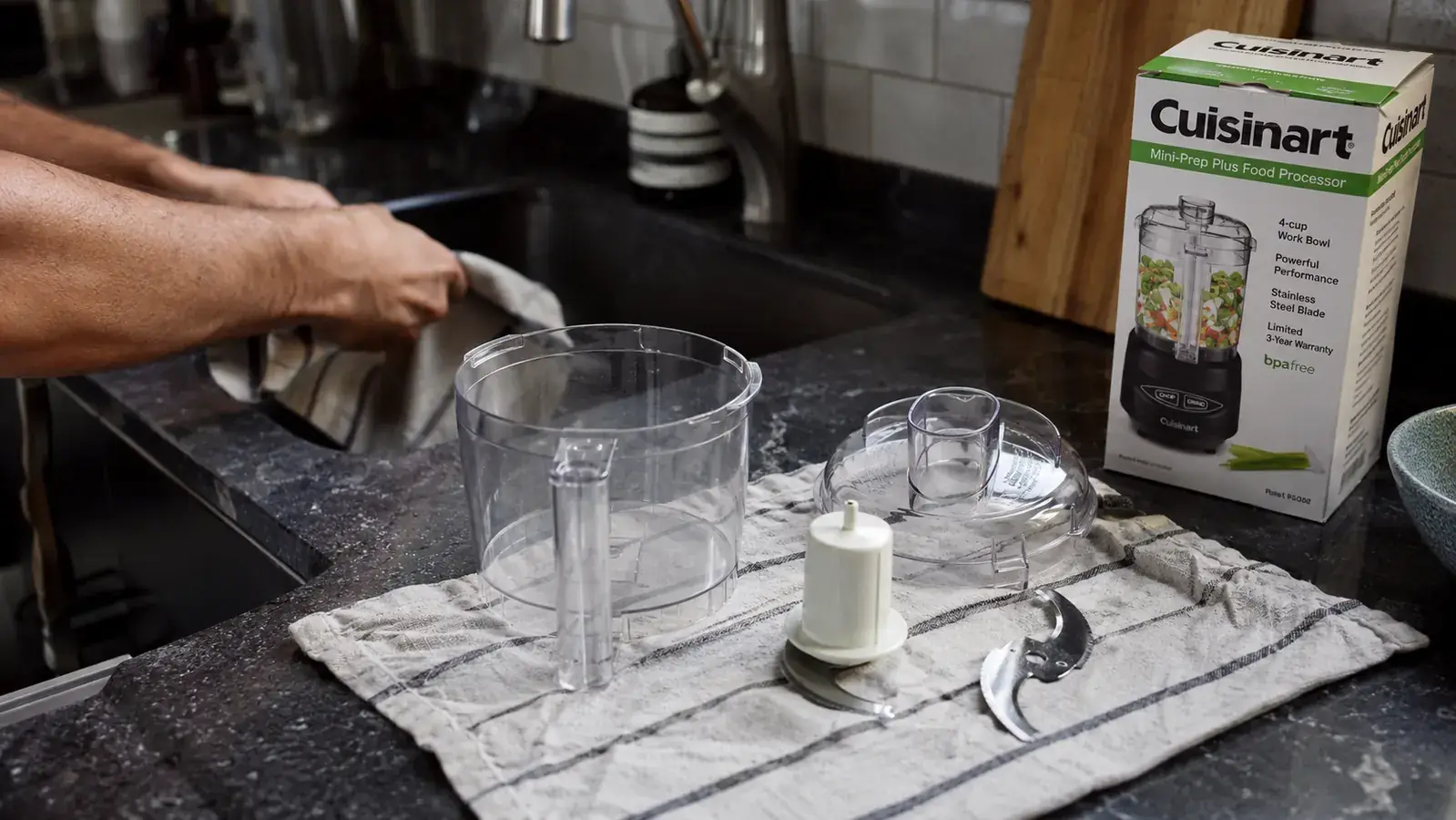
The Mini-Prep Plus has three parts that touch food: the bowl, the blade, and the lid. The bowl and lid are dishwasher safe (top rack). The blade is technically dishwasher safe but I hand wash it -- the edge stays sharper longer and dishwasher detergent is abrasive on metal over hundreds of cycles.
Hand washing the full setup takes about 90 seconds. Rinse the bowl immediately after use before anything has a chance to dry. Dried garlic or dried herbs require a soak. Wet garlic sluices off the bowl walls under warm water in seconds. The blade post has a small crevice at the base where food can collect -- a bottle brush or a folded paper towel clears it. That is the only slightly annoying cleaning detail I found.
The motor base never gets wet and never needs cleaning beyond an occasional wipe with a damp cloth. It does not accumulate grease the way a pan does. For an appliance that touches raw onion and garlic multiple times a week, the cleaning reality is as low-friction as it could reasonably be.
What I Liked
- Processes garlic, onion, and fresh herbs faster than any knife work by a significant margin
- 7-inch width is genuinely compact -- smaller footprint than a standard 4-slice toaster
- Reversible blade with Chop and Grind modes handles a wider range of tasks than a single-direction blade
- Rubber base grip keeps the unit stationary even when pressing down hard on the lid
- Bowl and lid are dishwasher safe for easy cleanup after everyday use
- 4.6-star rating across nearly 20,000 reviews reflects a product that consistently performs as advertised
Where It Falls Short
- Chop vs Grind mode logic is not intuitive on first use -- takes one session to internalize
- Loud at 80 to 85 decibels -- not a quiet appliance despite the small size
- Real working capacity for wet ingredients is around 2.25 cups, not the labeled 3 cups
- Struggles with dense pastes like hummus and thick nut butters -- motor runs hot at full capacity
- 60-second continuous run limit means large batches require rest cycles between rounds
- Blade removal requires care -- it is sharp and the small radius puts your fingers close to the edge
Who This Is For
The Cuisinart Mini-Prep Plus is the right buy if your cooking involves garlic, onion, and fresh herbs on a regular basis and you want to stop hand-chopping those three things. That is its core value. If you make one or two dinners a week that start with minced garlic and diced onion -- which describes most weeknight cooking -- this appliance removes the worst five minutes of prep from those meals and does it in a footprint smaller than a toaster.
It is also the right choice if you are replacing a full-size food processor you do not have room for. The Mini-Prep Plus handles 80 percent of what a large processor does for a solo cook or a couple cooking together. If you are not processing pounds of vegetables at a time or making batch hummus for a dinner party, you do not need the larger machine. The compact version does the daily work and takes up a fraction of the space.
And it makes sense if you are buying your first food processor and do not want to commit significant counter space before you know how often you will actually use it. The Mini-Prep Plus is low-risk in that sense -- it is compact enough that if it turns out you only use it twice a month, it does not dominate your counter the way a full-size unit would.
Who Should Skip It
Skip it if your primary goal is making smooth dips, thick sauces, or nut butters. The motor is not built for sustained high-resistance processing. A countertop blender with a tamper, or a larger food processor with a 7-cup or 11-cup bowl, handles those tasks without the thermal limit issue. The Mini-Prep Plus is a chopper and a mincer, not a power processor.
Skip it if you regularly cook for four or more people and need to process large batches in a single pass. Halving four onions for a big pot of soup means two or three Mini-Prep Plus batches with rest time between them. That friction is real, and at that volume, a larger processor is the more practical tool even if it takes up more counter.
And skip it if the noise ceiling is a hard constraint. The 80 to 85 decibel range is real. In a small studio with thin walls or in a household where someone sleeps on an unusual schedule, this machine operating at 7 a.m. or 10 p.m. is a neighbor or housemate issue. A knife is quieter. If noise is genuinely non-negotiable for your setup, a mandoline slicer or a sharp santoku and good knife skills are the less disruptive path for the same prep tasks.
If You Chop Garlic and Onions More Than Twice a Week, the Math Works Out.
The Cuisinart Mini-Prep Plus handles the most common small-kitchen prep tasks -- garlic, herbs, onion, nuts -- in a 7-inch footprint that fits on almost any counter. Check today's price on Amazon and see current availability.
Amazon Check Today's Price on Amazon →