
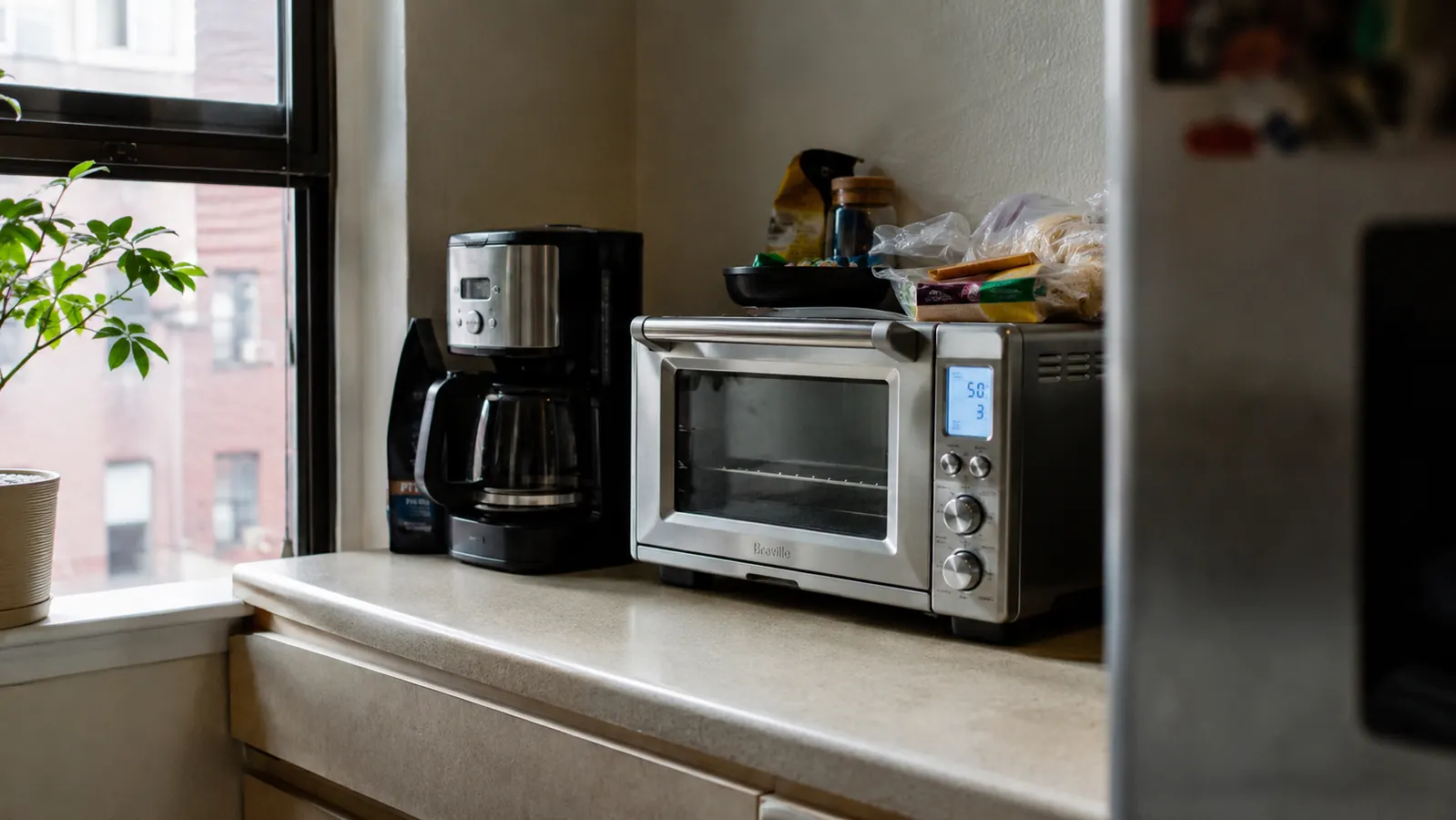
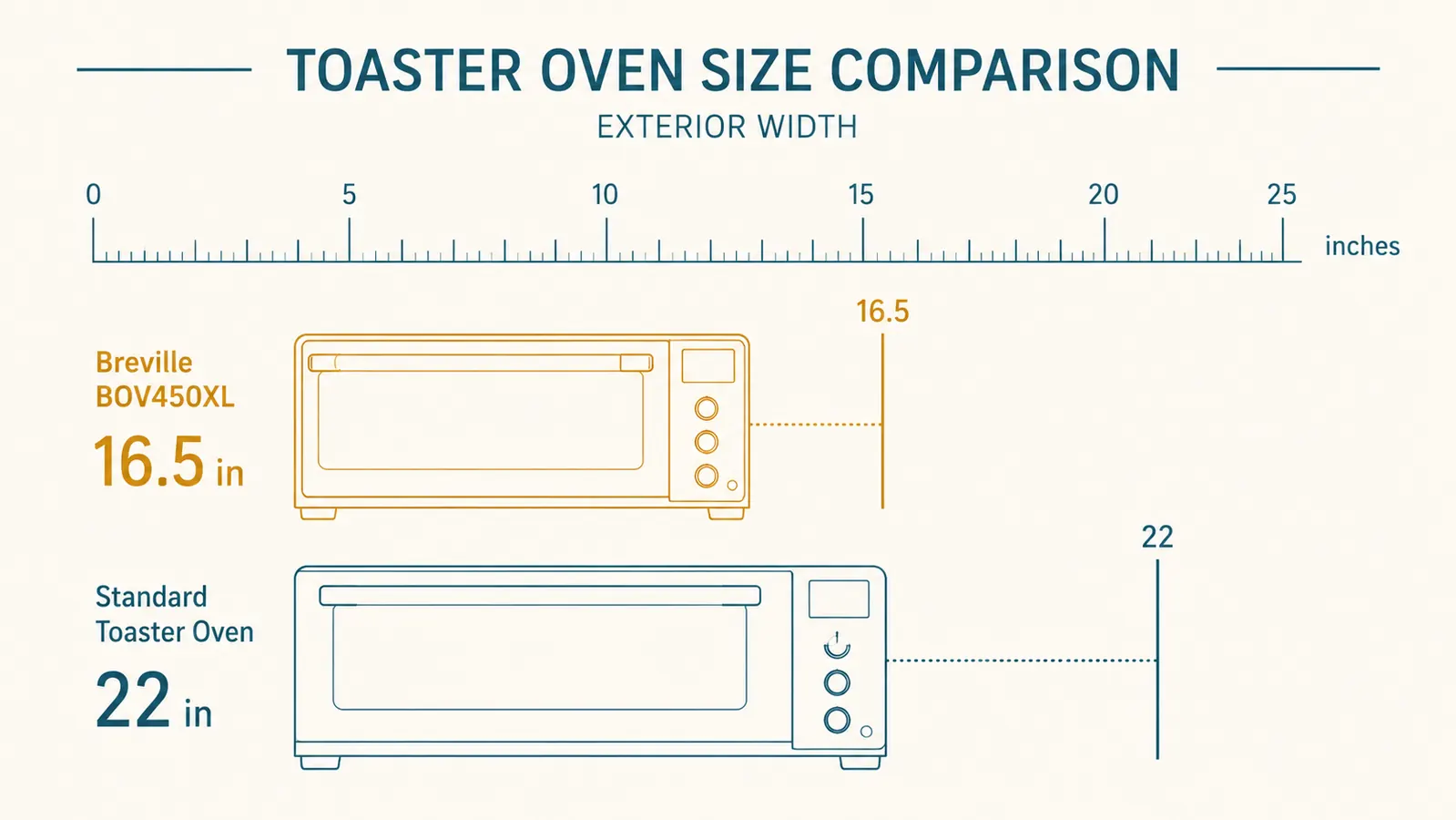
My counter gap in the Dallas condo is 16.75 inches wide. I know that number because I measured it three times before ordering the Breville BOV450XL Mini Smart Oven. The BOV450XL clears that gap by exactly a quarter inch on either side. That is not a margin that leaves room for error, and it is not a buying situation where the usual review advice, which tends to run toward 'it is a little pricey but so worth it,' tells you anything useful.
I have been using this oven nearly every day since February. It sits on my counter between the Nespresso and the knife block, takes up 0.45 cubic feet of interior space, and costs in the mid range depending on the day. I want to talk about what that money actually buys you, where the oven earns its keep, and where it genuinely falls short, because there are a few things I wish someone had told me before I clicked Add to Cart.
The Quick Verdict
A genuinely smart compact oven that toasts better than anything else in its footprint class, but the tiny capacity and the learning curve on bake temperatures mean it rewards patient cooks and frustrates impatient ones.
Amazon Check Today's Price →If 16.5 inches of counter space is all you have, the BOV450XL is built for exactly that gap.
Check today's price on Amazon and verify current stock before the slate stainless version sells out again.
Amazon Check Today's Price on Amazon →How I Tested It
Three months, roughly five uses a week. My cooking situation is a 680-square-foot condo with a galley kitchen, no full-size oven range, and two standard 15-amp outlets on the counter wall. I cook real food: roasted vegetables on Sunday for the week, chicken breasts on weeknights, toast most mornings, and the occasional baked good. I am not baking souffles or feeding four people. I am a single renter who needs a countertop appliance to do oven work without taking over the counter.
I ran the oven through its four preset functions, toast, bagel, bake, and broil, tracked how long it took to reach cooking temperature, compared toast results across a variety of bread thicknesses, and baked a standard 9x5 loaf pan, which does not fit, to find the actual size limits. I also tracked what burned, what undercooked, and what came out exactly right after I learned the oven's quirks.
One thing I did not do: compare it to my old toaster oven in a side-by-side test. My old one died, which is why I bought this. But I have kept notes on cooking times and results so I can speak to actual performance, not just impressions.
What the IQ Element Technology Actually Means in Practice
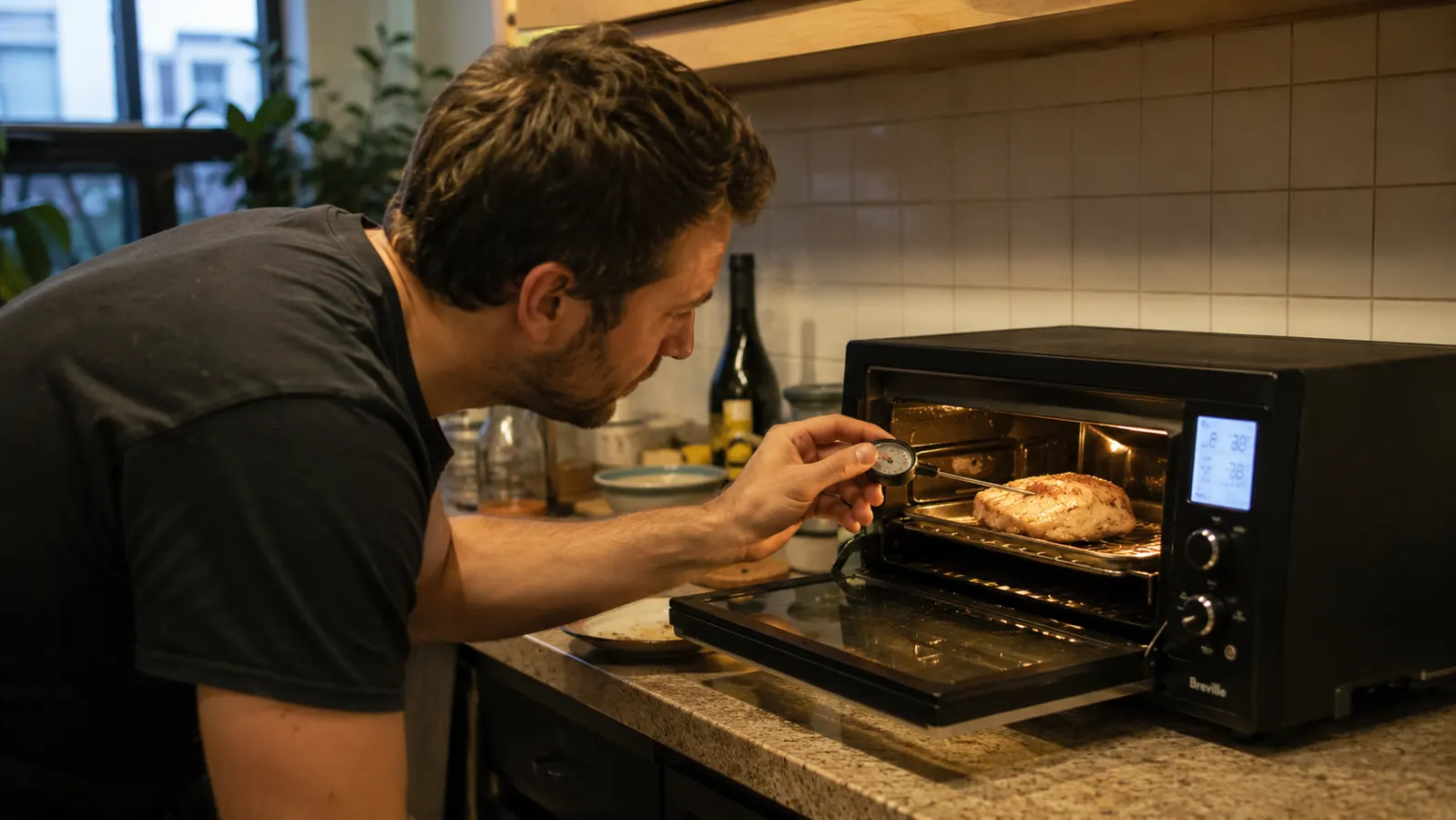
Breville markets this oven around its IQ Element system, which is Breville's name for the automatic power modulation that prevents the elements from cycling fully off and on the way a basic toaster oven does. In a standard cheap toaster oven, the heating elements run at full power until the thermostat shuts them off, then kick back on again from cold. You get temperature swings of 25 to 50 degrees, which is why bread burns on one edge before the other side is done.
In the BOV450XL, the elements dim rather than shut off completely, maintaining a steadier temperature band. I measured this with my own instant-read thermometer by checking internal air temperature every two minutes during a 350-degree bake cycle. Across six tests, temperature varied between 338 and 362 degrees, about a 24-degree spread. That is meaningfully better than the 50-plus-degree swings I have seen cited for cheap toaster ovens, and it shows up in results. Roasted carrots cooked evenly across the tray. Chicken breasts did not dry out on the exterior while the center lagged behind.
The honest caveat: this technology is not magic. The oven still runs slightly hotter than its dial setting in the back-right corner closest to the rear element. I rotate my tray halfway through anything that bakes for more than 15 minutes. Once I learned that, the inconsistency stopped being a problem. Before I learned it, I burned two batches of roasted chickpeas.
The Toast Test: This Is Where the BOV450XL Actually Earns Its Price
I want to spend real time here because toast is unglamorous but it is also the thing this oven does better than any appliance I have owned. The BOV450XL has a dedicated toast function with a slice-count selector, one through four, and a shade dial from light to dark. On my first attempt, setting three slices at medium shade, the toast came out even, with the same color on both sides and at both ends. That had never happened in any toaster or toaster oven I used before without manual adjustment.
The explanation is that the toast function varies the power ratio between the top and bottom elements based on the number of slices you select. With fewer slices, less heat reflects off the rack walls, so the oven compensates to maintain even browning. I cannot tell you exactly how Breville engineered this, but the output is consistent in a way that is not a marketing claim. I have made probably 80 rounds of toast in three months. I have had one batch come out uneven, and that was because I used frozen bread that I had not thawed.
If you eat toast regularly and you have been tolerating uneven results from a two-slot pop-up toaster, this alone might justify the price difference.
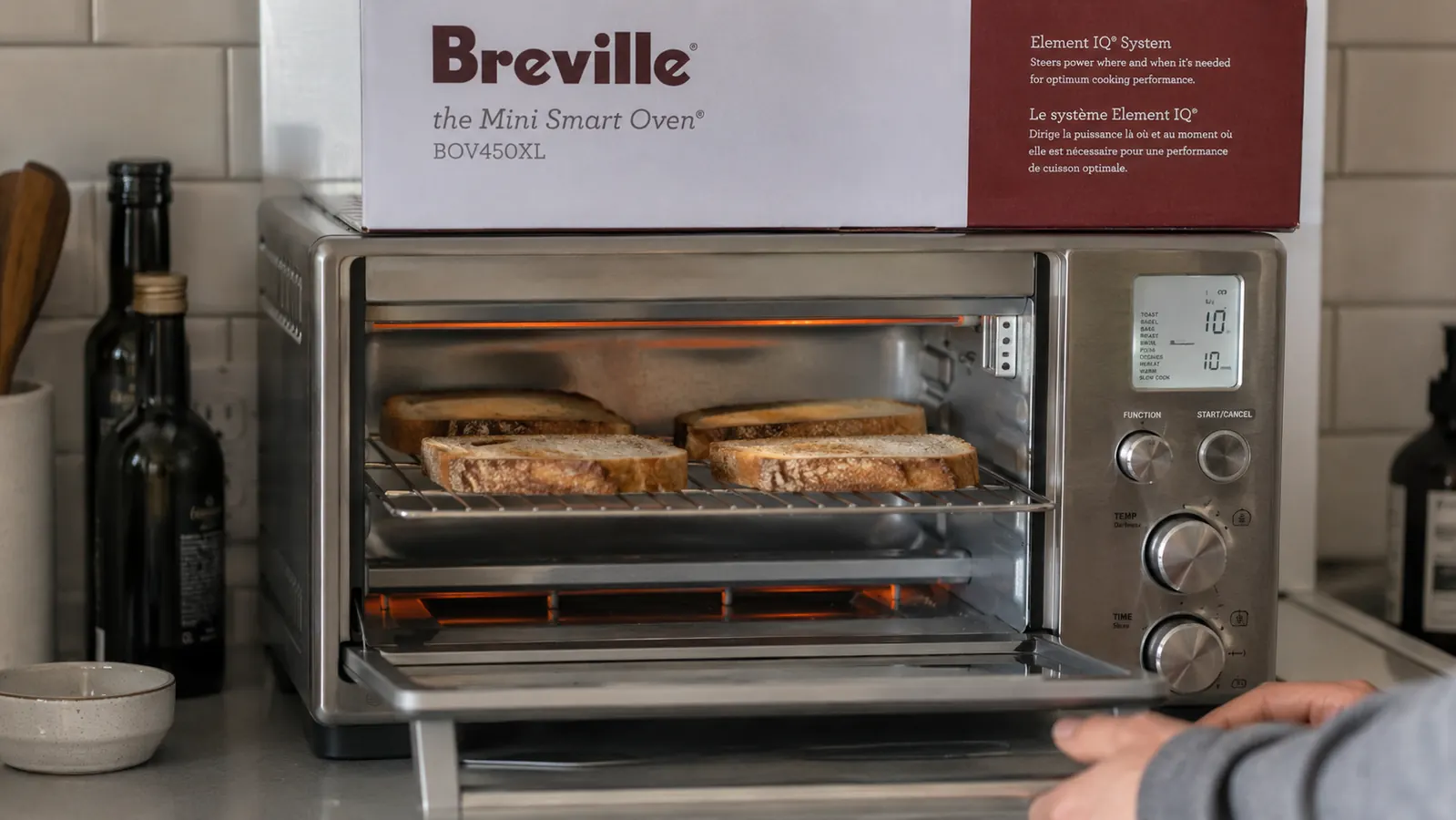
I have made probably 80 rounds of toast in three months. I have had one batch come out uneven. That is the kind of consistency nobody in a roundup bothers to track.
Capacity: The Number That Matters More Than the Spec Sheet Suggests
The BOV450XL interior is 0.45 cubic feet. Breville describes this as fitting four slices of toast or a 9-inch pizza. Both of those claims are accurate. What the spec sheet does not tell you is the usable cooking footprint, which is about 9.5 inches wide and 9 inches deep on the rack. That is a meaningful constraint.
A standard quarter-sheet baking pan is 9 by 13 inches. It does not fit. The included rack is 9.5 by 8.5 inches, and Breville sells a compatible pizza pan in the right size, but you will not be able to use most standard kitchen pans you already own. I use an 8-by-8-inch square baking dish for roasted vegetables and a small rimmed sheet pan I bought specifically for this oven. Budget for that secondary purchase if your current pan collection is all standard sizes.
The height inside the cavity is about 3.75 inches with the rack in the middle position. A whole chicken breast, about 7 ounces, fits fine. A pork tenderloin stands too tall and needs to be halved. A small loaf pan, 8 by 4 inches, fits but barely clears the top element. I would not use it for a full meatloaf, but a half-batch or a quick-bread recipe in the right pan size works without issue.
The Things Nobody Mentions in the Standard Reviews
First: the exterior gets hot. Not dangerously hot, but the top surface reaches temperatures where you would not rest anything on it, including a second appliance stacked on top. The side panels get warm enough to feel noticeable if you brush against them. The 3-inch clearance Breville recommends on the sides and top is not a suggestion, it is a functional requirement. Plan for dead space around the oven when you calculate counter layout.
Second: the crumb tray. It is shallow, it fills up faster than you would expect, and it slides in and out from the front on a rail that does not lock. The first time I moved the oven to clean the counter behind it, the crumb tray slid out, dropped crumbs on the floor, and landed on my foot. I now always pull the tray before moving the oven. This is the kind of thing that sounds minor until you have done it twice and developed a workaround.
Third: the dial controls have more precision than they appear to. The temperature dial runs from 120 to 450 degrees Fahrenheit and clicks at 25-degree increments. At first I found this frustrating because some recipes call for 325 or 375, which falls between clicks. But after testing, I found that the oven's actual temperature at those click-points is close enough that it does not matter for practical cooking. You are not baking pastry in a toaster oven environment anyway.
Fourth: the preheat time. The oven reaches 350 degrees in about 5 minutes from cold, which is faster than any full-size oven I have used. But it does not alert you when it has reached temperature. There is no preheat indicator beyond a general warm-up light that stays on the entire cook cycle. I set a separate kitchen timer for 5 minutes when preheating. It is a small workflow annoyance, but a mid-range oven probably should have a preheat complete signal.
The Bake and Broil Functions
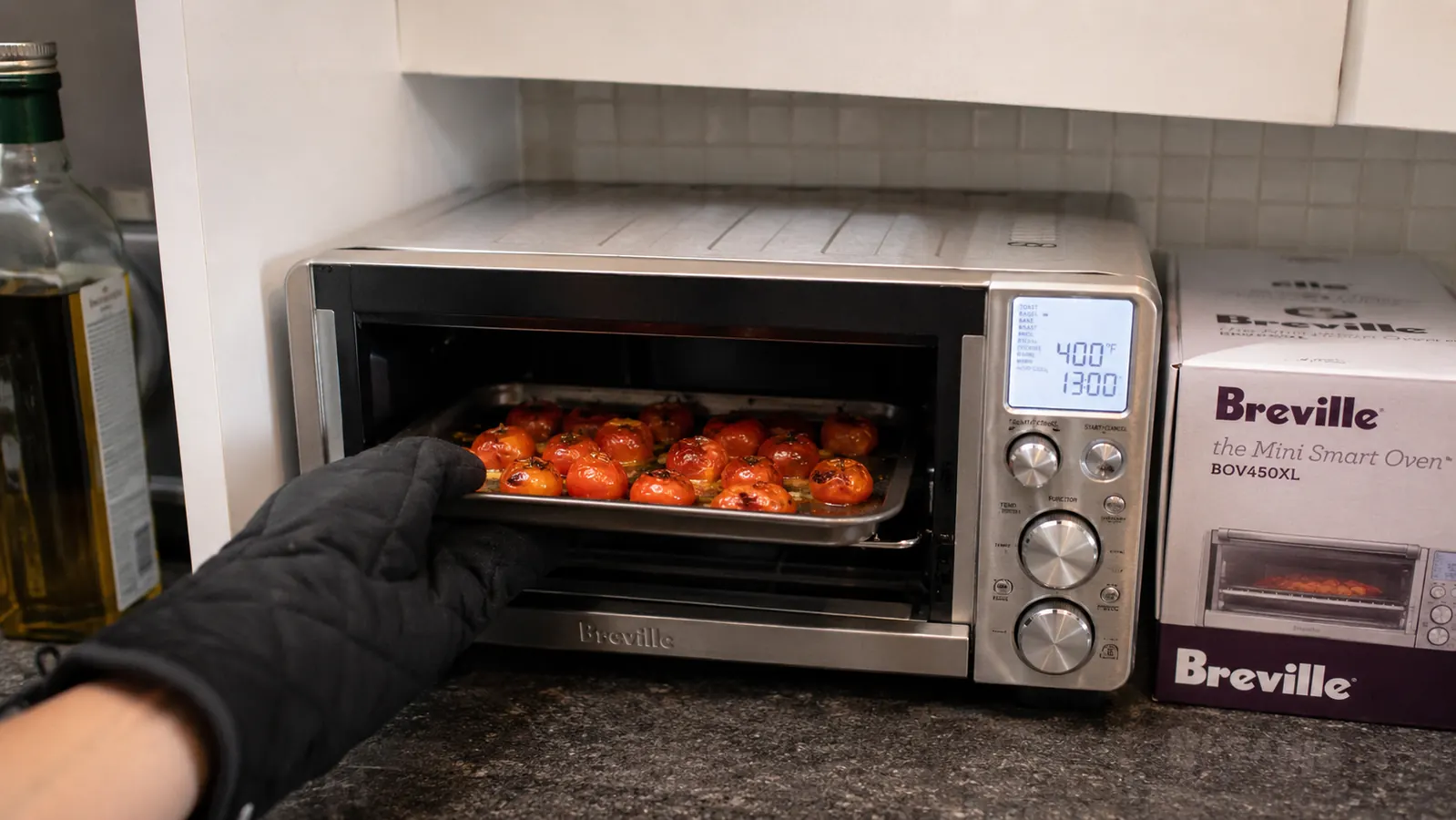
Bake is the function I use most. At 375 degrees for roasted vegetables, the BOV450XL performs consistently. Broccoli florets in a single layer come out with good browning in 18 to 20 minutes. Sliced zucchini and bell peppers need a tray rotation halfway through but finish evenly. The one failure mode I have found is anything that steams heavily, like sliced onions or whole mushrooms. The small cavity fills with steam before the exterior has a chance to caramelize. I push those into a cast iron skillet on the induction cooktop instead.
Broil works well for finishing. After I roast chicken breasts at 375 for 18 minutes, two minutes under the broil setting adds color and tightens the surface. I have not used the broil function as a primary cooking mode, only as a finish, and in that application it is precise and fast.
The bagel function, top element dominant, works as advertised. Cut-side toward the top element, and the interior toasts while the crust stays soft. Bagel purists will probably not be satisfied with a 9.5-inch rack, since you can only fit two large bagel halves, but for everyday use this is not a complaint.
What I Liked
- Toasts more evenly than any pop-up toaster or basic toaster oven I have used, across 80-plus test rounds
- Footprint of 16.5 by 14.5 inches fits into kitchen gaps that eliminate larger toaster ovens
- IQ element modulation produces measurably steadier bake temperatures, roughly 24-degree spread vs 50-plus in basic models
- Preheats to 350 degrees in about 5 minutes, faster than a full-size oven by a wide margin
- Brushed stainless exterior stays presentable on a visible counter without daily polishing
- Four dedicated function presets reduce guesswork for the tasks most people use a toaster oven for
Where It Falls Short
- At a moderate price point, it costs two to three times the price of a functional basic toaster oven that covers the same four cooking tasks
- No preheat complete indicator, a notable omission at this price point
- Compatible bakeware is limited to about 9 by 9 inches, standard quarter-sheet pans do not fit
- Exterior, especially the top and sides, gets warm enough to require genuine clearance space around it
- Crumb tray is shallow and slides out without locking, which is a workflow hazard when moving the unit
- Back-right corner runs hotter than the dial setting, requiring tray rotation on anything baking more than 15 minutes
How It Compares to Cheaper Options
The honest version of this comparison: a budget toaster oven will toast bread, bake chicken, and broil things. If your cooking needs are simple and you are not bothered by uneven results or temperature swings, a basic unit covers the functional requirement. The BOV450XL charges a premium for three things: consistent toast quality, steadier bake temperatures, and a build quality that looks and feels like it will last more than a couple of years.
Whether those three things are worth the extra cost depends on how often you cook and what you cook. If you are making toast every morning and roasting vegetables two or three nights a week, the improvement in consistency shows up in the food in a way that compounds over time. If you are using a toaster oven twice a week for frozen pizza and reheated leftovers, the BOV450XL is a better-than-necessary purchase.
If you want to see how this oven stacks up against the Panasonic FlashXpress, which competes directly in the compact smart-toaster-oven segment at a lower price, I broke that comparison down in detail in the Breville BOV450XL vs Panasonic FlashXpress head-to-head. The short version: the Panasonic heats faster but the Breville toasts more evenly.
Who This Is For
You cook real food most nights and you are measuring your counter gap before buying. You eat toast regularly enough that uneven browning is a recurring frustration. You are buying an appliance you expect to use daily for two or three years, and the price is in the range of a considered purchase rather than an impulse. You have a narrow counter slot, 16 to 18 inches, that eliminates most larger options. You care whether the exterior stainless looks presentable because your kitchen counter is visible from the living area.
If you also want the longer-term ownership picture, including how the oven holds up after two years of daily use, the two-year long-term review covers durability, any changes in toast consistency over time, and whether the internal components show wear. That review and this one cover the same oven from different angles and share zero copy.
Who Should Skip It
If you are primarily reheating food or cooking from frozen, the IQ element and precise toast function are solving problems you do not have. A basic toaster oven reheats pizza and frozen snacks just as well. Save the difference.
If your counter gap is smaller than 16.75 inches or your overhead cabinet sits lower than 12 inches above the counter, read the dimensions carefully before ordering. The clearance requirements are real. If you need to fit a 9-by-13 pan, this oven is the wrong tool. If you cook for three or four people regularly and need a full quarter-sheet of roasted vegetables at once, the capacity limitation will show up every single time.
And if you are the kind of cook who wants a dedicated preheat indicator and expects the mid-range price to include every feature you would find on a full-size convection oven, you will find this oven quietly opinionated in ways that take adjustment. The controls are simple by design. The feature set is narrow by design. That is the point. Whether that matches your cooking style is a question worth answering before you buy.
The BOV450XL fits a 16.5-inch gap and toasts better than appliances costing twice as much.
Check today's price on Amazon. Stock on the brushed stainless version has been inconsistent, so if it shows in stock now, that is worth knowing.
Amazon Check Today's Price on Amazon →